
Do soundproof curtains work when outside noise disrupts your comfort? The right curtains can help create a quieter indoor space by absorbing sound, reducing echoes and softening some noise coming through windows. While they cannot completely block traffic, loud conversations or deep bass, heavy acoustic fabrics with a close fit can make a noticeable difference. The results depend on the curtain material, window coverage and gaps around the frame.
What Do Soundproof Curtains Actually Do?
Soundproof curtains can absorb some sound inside a room and, depending on how they are made, reduce some sound passing through the covered opening. These are different jobs, and a curtain that performs well at one may not do much for the other.

Sound absorption means taking some energy out of sound that would otherwise bounce around a room. Thick, folded fabric helps with this, so voices may sound clearer and a bare room may feel less harsh after curtains are fitted. The outside noise may not have changed much, even though the room feels quieter.
Sound insulation means reducing sound as it travels from one space to another. That normally needs weight, airtight seals, and a barrier with few weak points. Curtains hang loosely and leave gaps around their edges, which limits how much sound they can block.
Some specialist curtains include a dense barrier layer as well as absorbent fabric. They can offer more noise reduction than an ordinary lined curtain, but the whole fitted system matters, not just the number of layers.
When choosing soundproof curtains, start by deciding whether you need less echo or less outside noise. This guide from Design Furniture explains how to tell the difference before spending money.
Which Noises Can Curtains Reduce?
Heavy curtains are more likely to soften speech and higher-pitched sounds than deep bass or vibration. They help most when the covered window is a main route for noise, rather than when sound travels through walls, floors, or an open vent.
| Noise or Problem | What Curtains May Do | Main Limit |
|---|---|---|
| Echo in a room with bare floors and walls | Reduce reflections and make speech easier to follow | One covered window may not provide enough absorption for a large room |
| Voices outside a closed window | Soften some speech, depending on the curtain and window | Words may remain clear through gaps or weak glazing |
| General road noise | Take some sharpness out of passing traffic | Low engine rumble is harder to reduce |
| Music from next door | Reduce some room reflections | Bass and sound passing through a shared wall remain |
| Footsteps from upstairs | Usually make little difference | Impact travels through the building structure |
| Drilling or construction nearby | Possibly soften part of the airborne sound | Vibration and powerful low-frequency noise remain |
| An air conditioner inside the room | Reduce some reflected fan noise | The unit itself still needs attention if it rattles or vibrates |
A common mistake is buying a curtain for a window when the sound is entering somewhere else. For example, voices heard clearly near an apartment entrance may be coming through the door seals, even if the room also has a large window.
With the window closed, listen near its edges, then near the door, walls, and any vents. This is only a rough check, but it can help you decide what to investigate first. Never block a vent that provides required ventilation.
When choosing bedroom curtains, consider noise and light as separate sleep problems. A lining that darkens the room may help with light at night, but it does not prove the curtain can reduce traffic noise.
How Much Noise Reduction Should You Expect?
There is no reliable decibel reduction that applies to all soundproof curtains. A useful claim needs a test report for the actual product, with details of the sound tested and how the curtain was fitted.
Be cautious with a headline such as “reduces noise by 20 dB” if it gives no further detail. Decibels, written as dB, measure sound level, but a result at one pitch is not a promise of the same reduction across traffic, voices, and bass.
Ask the seller these questions before using a number to guide your purchase:
- Was the test about sound absorption or sound passing through a barrier?
- Did it test the complete curtain or just a small fabric sample?
- What were the curtain size, folds, edge gaps, and mounting arrangement?
- Does the report show results across a range of pitches, rather than one best result?
- Was a window included, and does that setup resemble your room?
An NRC rating describes how well a material absorbs sound in a standard test. It does not tell you how much street noise a curtain will block. An STC rating concerns sound passing through a tested barrier, but even that result applies to the tested setup and does not fully describe deep traffic rumble.
How to Check the Difference at Home
Compare the room with the curtains open and closed while keeping the window, door, and sound source unchanged. A steady sound is more useful than passing traffic, because two vehicles can produce very different noise levels.
Listen from the same place each time and notice whether speech is less clear, sharp sounds are softer, or only the room’s echo has changed. A phone sound meter can help you spot a rough difference, but phone microphones and automatic settings limit accuracy, especially for bass. A home comparison is not a substitute for a product test report.
What Should You Look for Before Buying?
Look for a curtain designed for the job you need, with clear fabric details and a practical fitting plan. Weight, layers, folds, and coverage matter more than the word “soundproof” on the packaging.

| Detail to Check | Why It Matters | What to Ask |
|---|---|---|
| Fabric weight per square metre | Gives a fairer weight comparison than the total weight of panels in different sizes | Is the quoted weight for the face fabric or the complete curtain? |
| Inner layers | Absorbent layers and dense barrier layers do different jobs | What is each layer meant to do? |
| Fullness | Folds add fabric and help sound absorption | How wide will the curtain be when laid flat? |
| Side and top coverage | Large gaps let sound pass around the fabric | Can the track extend beyond the window and return toward the wall? |
| Test evidence | Helps separate a measured product from a marketing label | Can I see the report for this exact curtain construction? |
| Track capacity | Heavy curtains put more load on tracks, brackets, and fixings | Is the complete system rated for this curtain weight? |
Blackout curtains block light, but a thin blackout coating does not automatically provide strong sound insulation. A heavy lined blackout curtain may help with both needs, though its ability to reduce sound still depends on how it is made and fitted.
Sheer curtains are useful for daytime light control, not as a serious barrier to outside noise. They can sit behind a heavier curtain, but adding a sheer layer should not be treated as a soundproofing upgrade.
The curtain’s heading, or top edge, also affects the gaps. Eyelet curtains leave openings around the pole, while a well-planned track can provide closer coverage at the top and let the sides turn back towards the wall. Neither arrangement creates an airtight seal.
For a wider buying checklist, the guide to choosing home curtains covers room needs beyond noise. If you want a blind behind the curtain for light control, read about using blinds and curtains together, but do not assume that two ordinary window coverings equal tested sound insulation.
How Should Soundproof Curtains Be Fitted?
Fit soundproof curtains so they cover the whole window opening with generous folds and as few open edges as practical. A better fit can help them work well, though it cannot turn an ordinary curtain into a sealed sound barrier.
- Check the window first. Repair loose seals, damaged frames, or a sash that does not close properly. A heavy curtain cannot make up for a gap that lets air through.
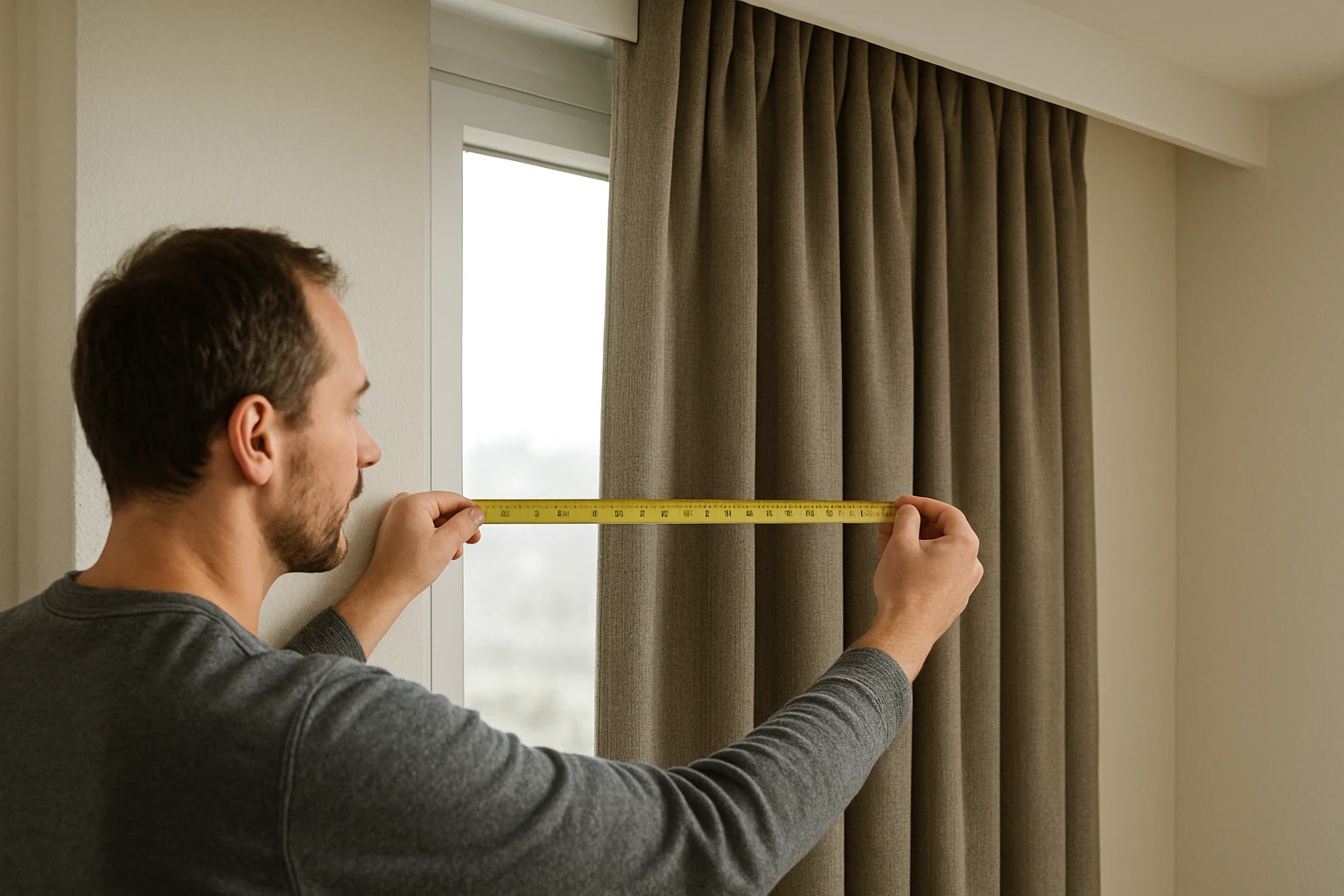
- Plan coverage beyond the glass. Where space allows, extend the curtain beyond the window on both sides and above it. Around 15 to 30 cm of side overlap is a useful starting point for planning, not a tested rule for sound control.
- Allow enough fabric for folds. Roughly two to two-and-a-half times the track width is a common starting point for a full curtain, though the heading and fabric may need a different amount.
- Reduce edge gaps. Side returns bring the curtain ends back towards the wall, and a centre overlap avoids a straight opening between two panels. Leave some space between the curtain and glass rather than pressing fabric against it.
- Use suitable hardware. Fix the track into a support that can carry the full curtain load, and keep the fabric clear of heaters, vents, and walking routes.
For example, a 2-metre track at twice fullness needs about 4 metres of flat curtain width in total, before allowing for hems, overlaps, pattern matching, or the chosen heading. That is a fabric-planning example, not a promise of a particular noise reduction.
A small gap above the floor is often safer and easier to keep clean than fabric pooling on it. Where curtain installation in Dubai involves wide windows or heavy layers, ask the fitter to check the wall or ceiling fixing points before finalising the design.
With motorised curtains, the motor and track must suit the finished curtain weight and span. Automation makes heavy panels easier to move, but does not itself improve sound control.
Are Soundproof Curtains Worth Buying for Your Room?
Soundproof curtains are worth considering when you want less echo, need curtains anyway, and would welcome a modest reduction in some outside sounds. They are a poor main solution when the problem is deep bass, building vibration, or a badly sealed window.
| Your Main Problem | Best First Step | Where Curtains Fit |
|---|---|---|
| Voices sound harsh in a bare room | Add sound-absorbing furnishings | Heavy folded curtains can be a useful part of the change |
| Noise is strongest at the window edges | Check seals and closure | Add curtains after dealing with leaks |
| Traffic remains loud through a closed, well-sealed window | Assess the glazing and frame | Curtains may be a supporting measure rather than the main fix |
| Bass comes through a shared wall | Investigate the wall and other sound paths | A window curtain is unlikely to solve the cause |
| Footsteps travel from upstairs | Address impact at the floor or ceiling system | Curtains offer little direct help |
Secondary glazing, which adds another pane inside the existing window, or suitable acoustic glazing may be worth considering when window noise remains serious. How well it works depends on the pane types, spacing, seals, and frame, so ask for evidence for the complete system rather than choosing on glass thickness alone.
For a renter, removable heavy curtains may be easier to arrange than window changes, but check permission before drilling or changing seals. For a homeowner, repeated curtain upgrades can become poor value if the real fault is the window itself.
Before ordering curtains, describe the noise, when it happens, and where it sounds loudest. You can contact Design Furniture to discuss fabric, coverage, and installation, while asking separately for any sound test evidence behind a product claim. Choose curtains for the results they can help you achieve, not the silence their name might suggest.
Frequently Asked Questions
Can Soundproof Curtains Stop People Outside Hearing My Conversations?
Soundproof curtains cannot guarantee that conversations will stay private. Sound can escape around the fabric, through doors, and through other weak parts of the room. If speech privacy matters, do not rely on curtains alone, and have the full room assessed before using it for confidential calls or meetings.
Will Two Pairs of Curtains Block More Noise Than One?
A second pair of heavy curtains may help, but it will not reliably double the noise reduction. Extra fabric can absorb more reflected sound, while gaps around both layers still allow sound through. Check the track capacity and leave enough room for both pairs to close fully without pushing each other aside.
Can Soundproof Curtains Help with Dog Barking?
Heavy curtains may soften some dog barking coming through a closed window, but they are unlikely to make it inaudible. Barking varies in pitch and loudness, and gaps in the window can limit any benefit. Check the window seals first, then judge curtains as a possible supporting measure rather than a complete fix.
Can I Wash Soundproof Curtains in a Washing Machine?
Only machine-wash soundproof curtains if the care label allows it. Dense inner layers, coatings, and bonded linings may shrink, separate, or lose their shape with the wrong cleaning method. Check the instructions for the complete curtain rather than the face fabric alone, and consider the wet weight before using a domestic machine.
Can Heavy Curtains Cause Condensation on Windows?
Heavy curtains can contribute to condensation by limiting warm room air reaching cold glass, especially when indoor humidity is high. They do not create the moisture themselves, and the risk depends on ventilation, temperature, and the window. Open the curtains regularly, check behind them for dampness, and keep required vents clear.