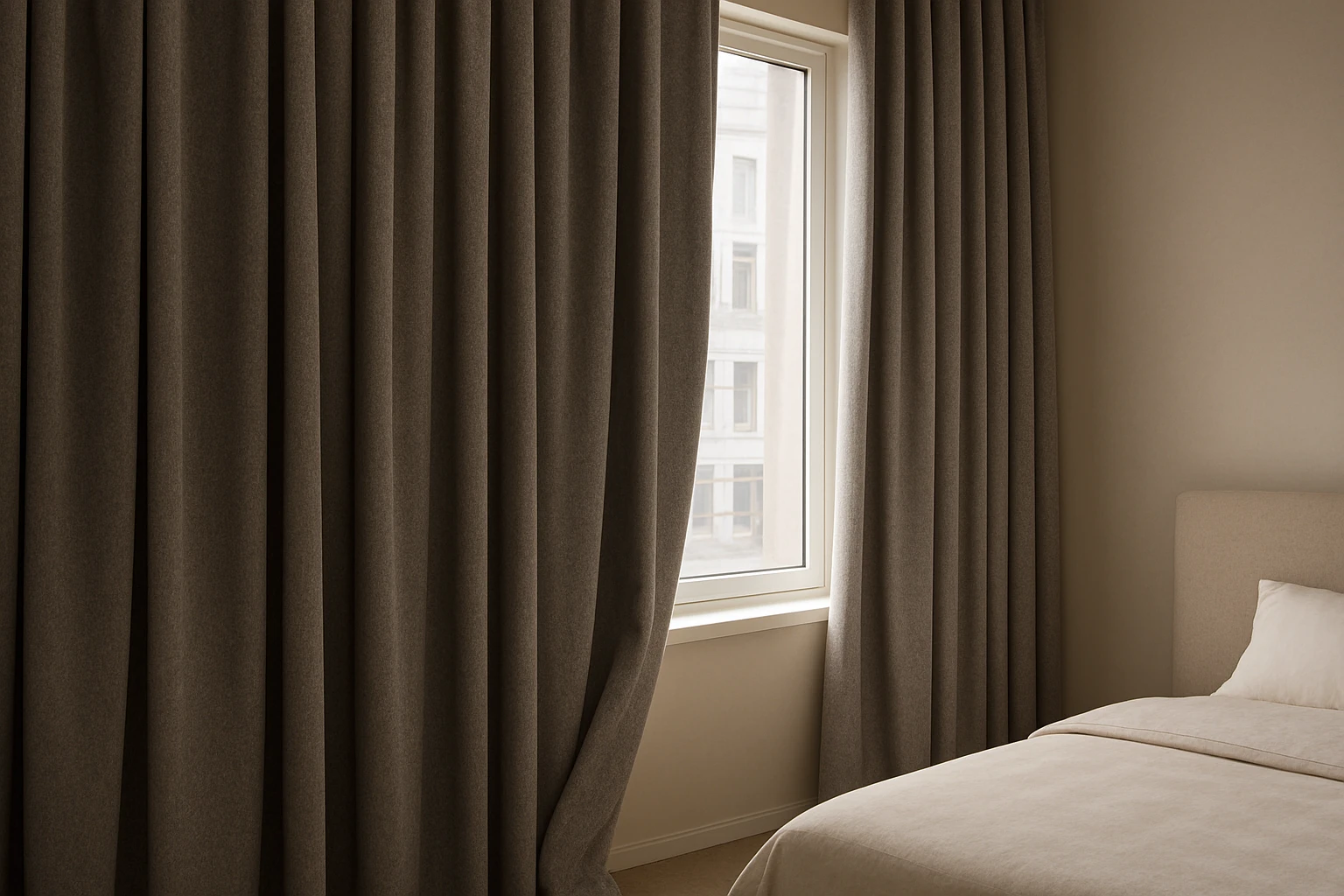
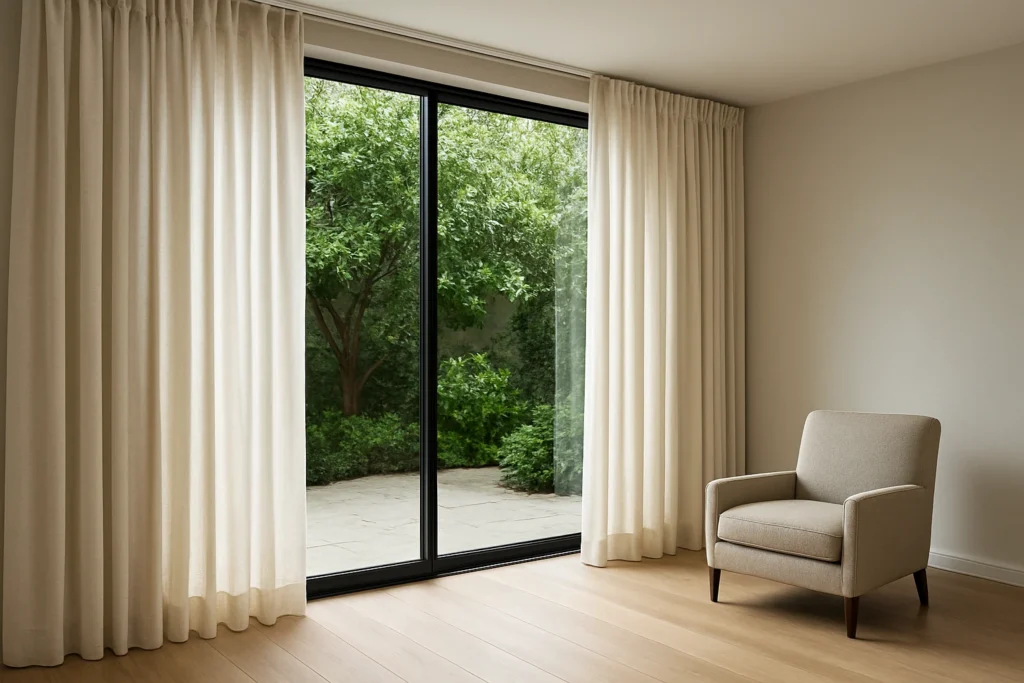
The best curtain ideas for sliding glass doors include ceiling-mounted wave curtains, sheer panels with a separate blackout layer, and simple linen-look drapes. Choose curtains that gather away from the door opening, clear the handle, and hang just above the floor so the door stays easy to use. Match the fabric to your needs for daylight, nighttime privacy, and protection from strong sun.

Which Curtain Layout Keeps a Sliding Door Easy to Use?
A sliding door works best with curtains that gather away from the main opening. Before choosing fabric with Design Furniture, check which glass panel moves, where people step through, and how much wall space is available beside the frame.

The main choice is between a one-way draw, where all the fabric gathers at one end, and a split draw, where two curtains meet in the middle. Neither is always better. The door layout determines which works well.
| Door or Room Layout | Curtain Arrangement | What to Check |
|---|---|---|
| One moving panel used every day | One-way draw toward the fixed panel or nearby wall | Gathered fabric must stay clear of the handle and walking route |
| Wide door with useful wall space on both sides | Two panels with a center opening | The curtain meeting point should not make daily access awkward |
| Furniture close to one side | Gather the curtain on the opposite side | Check that the fabric can move without catching on furniture |
| Almost no wall space beside the frame | Extend the track where possible, or accept some covered glass | Ask how much space the open curtain will occupy before ordering |
| Several sliding panels with different opening positions | A track layout planned around the main access point | Check access with the door in its usual open position |
The space a curtain takes up when open is called its stack-back. Thick fabric, deep pleats, and a second layer all increase it, so extending the track slightly beyond the door does not always leave the glass clear.
Ask the supplier to estimate stack-back for your chosen fabric and heading, which is the way the curtain is finished at the top. For a busy balcony door, easy access matters more than making the two sides look perfectly equal.
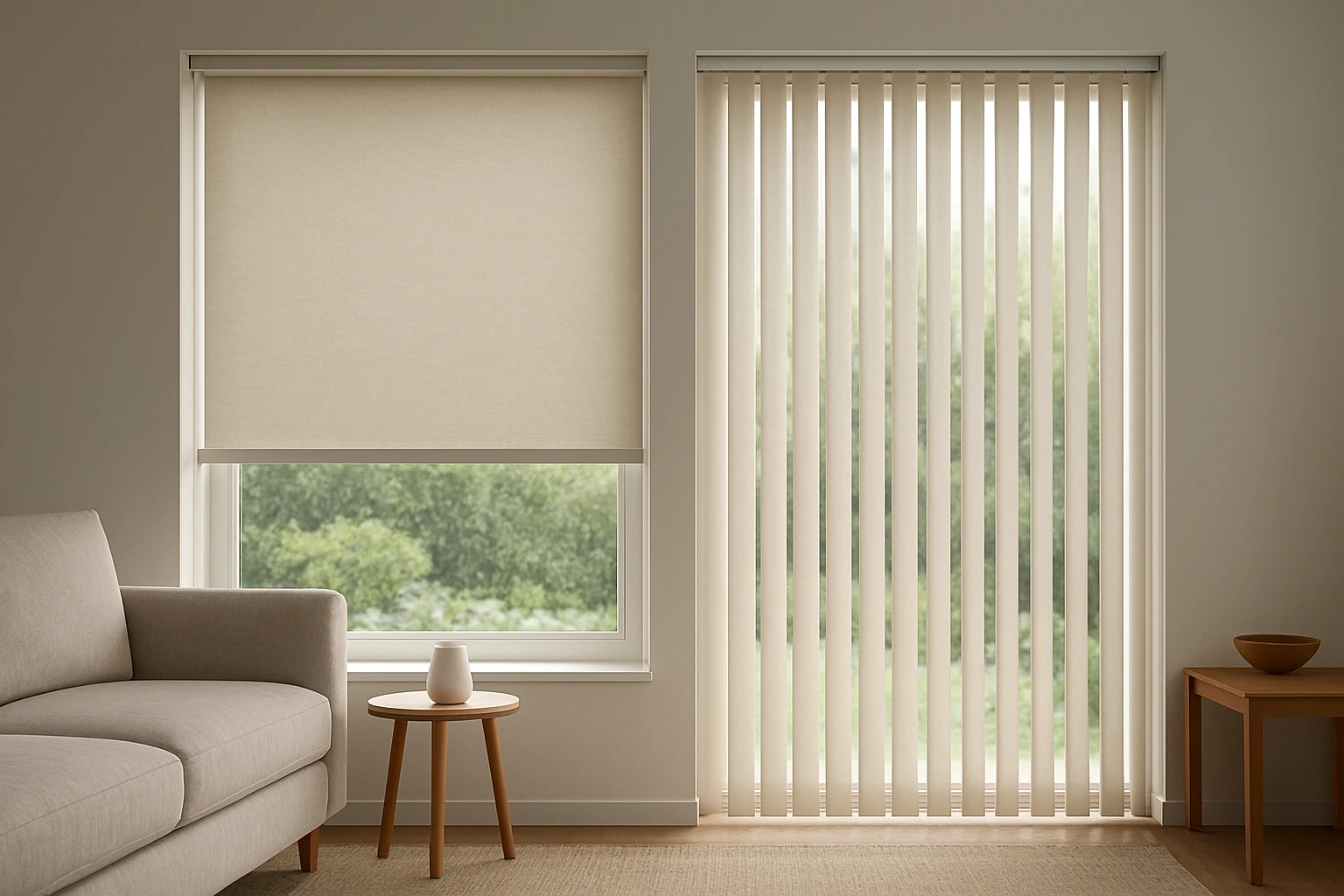
If wall space is very tight, compare curtains and blinds for sliding doors before committing to a bulky curtain arrangement.
Seven Curtain Ideas for Sliding Glass Doors
Choose sliding glass door curtains by the job they need to do, then decide on the style. Sheers suit rooms that need soft daylight, lined curtains offer more privacy, and layered curtains let you switch between the two.

| Curtain Idea | Best Fit | Main Advantage | Main Limitation |
|---|---|---|---|
| Full-height white sheers | Living rooms with a private outlook | Soften daylight without hiding the whole view | Do not provide reliable privacy at night |
| Sheers with separate blackout curtains | Bedrooms and overlooked apartments | Flexible light and privacy control | Need two tracks and more room for gathered fabric |
| Linen-look drapes | Relaxed, neutral rooms | Add texture without a strong pattern | Unlined fabric may reveal silhouettes |
| Wave curtains | Modern rooms and wide glass doors | Form regular folds with a neat finish | Need a matching track and heading system |
| Pinch-pleat curtains | Traditional or tailored interiors | Hold a structured shape | Gathered pleats can take up more space |
| Patterned or color-block curtains | Plain rooms that need a focal point | Add interest across a large wall | Strong patterns can compete with a busy view |
| A single wide blackout panel | Bedrooms with a clear parking side | Offers privacy with one main curtain edge to move | A wide, heavy panel needs suitable hardware |
Sheers and Layered Curtains for Changing Light
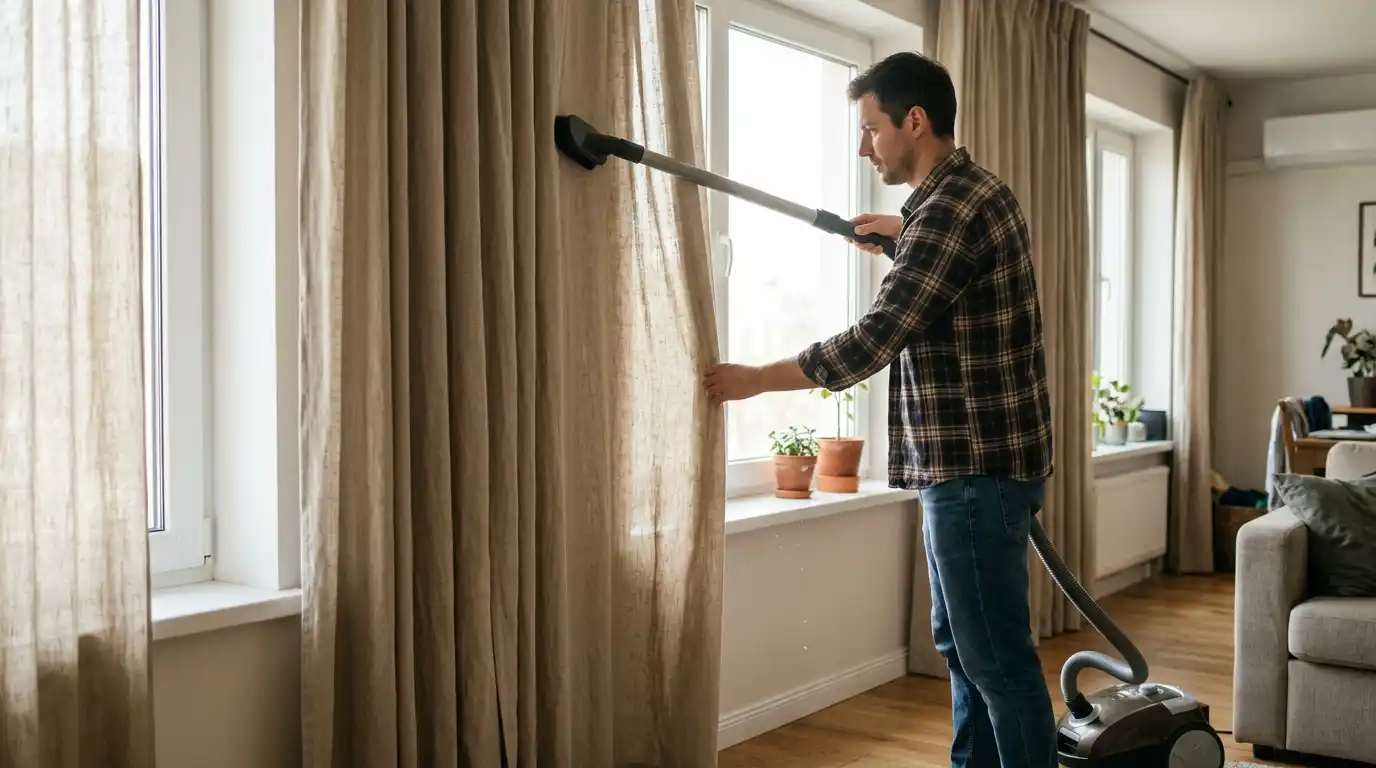
Sheer curtains work well when you want to soften a bright view rather than block it. Choose a washable fabric for a balcony door you open often, since dust and outdoor air reach the curtain each time you use the door.
Sheers alone are a poor choice for a bedroom that neighbors can see into. When the room is brighter than the outdoors, people outside may see through the fabric, so add a separate opaque layer for evening privacy.
With double curtains, place the sheer layer nearest the glass and the heavier curtain toward the room. Check that the two layers can move without rubbing, and allow enough room for both sets of folds when open. Two closely packed tracks may fit on paper but leave the curtains dragging against each other.
Linen-Look, Patterned, and Color-Block Curtains
Linen-look curtains suit sliding doors because their visible weave softens the hard lines of the glass and frame. A polyester or blended linen-look fabric can be easier to care for than pure linen, though the care label and lining matter more than the name alone.
For patterned curtains, look at a large sample held upright rather than a small swatch laid on a table. A bold print may disappear into deep folds, while a small repeating pattern can look busy across a wide door.
A darker bottom border can add contrast to a pale curtain, but it is not a substitute for floor clearance. If the hem brushes a dusty balcony threshold, the fabric will still pick up dirt.
Wave Curtains or Pinch Pleats?
Wave curtains use specially spaced gliders and heading tape to create soft, even folds. Pinch-pleat curtains have small stitched groups of pleats at the top, which give them a more formal shape.
Choose wave curtains for a clean, modern look, but confirm how much space they need behind and in front of the track. Their folds extend on both sides, so a track fitted too close to the wall or door handle can cause rubbing.
Pinch pleats suit rooms with classic furniture or detailed trim. They can also work on a track, so a traditional heading does not mean you must use a pole. The choice of curtain hooks affects how the fabric hangs and how easily you can adjust its finished height.
How to Measure Curtains for Sliding Glass Doors
Measure for the full curtain setup, not just the glass. The final size must allow for the frame, how far the handle sticks out, the gathered fabric, and the distance from the track or pole to the floor.

- Measure the full frame width. Include the outer trim rather than measuring only the visible glass.
- Mark where the curtain will gather. Work out whether it will sit over the fixed panel, beside the frame, or partly across both.
- Set the track or pole width. Add space for the gathered curtain where the wall allows, and check for nearby switches or cupboards.
- Measure the handle projection. The hanging fabric and its folds need to clear the handle, not just the glass.
- Measure the finished drop in several places. Floors and ceilings are not always level, especially across a wide opening.
- Confirm the supplier’s measuring method. Some orders use track width, while others ask for flat fabric width or finished curtain width.
A Worked Width Example
Suppose a sliding door frame is 240 cm wide and the planned track is 300 cm wide after allowing space beside the frame. For a gathered curtain using twice the track width in flat fabric, the total fabric width would be about 600 cm.
If the same heading and fabric need 2.5 times fullness, the total would be about 750 cm. Fullness describes the extra fabric used to create the folds. These figures are examples, not a rule for every curtain.
Wave systems use specific tape and glider spacing, while pinch pleats take up fabric in their sewn folds. Give the supplier the track width and chosen heading rather than relying on a general multiplier alone. Pattern matching, side hems, and seams also affect how much fabric must be cut.
For ready-made panels, check what the stated width means. Two flat panels measuring 140 cm each provide 280 cm of fabric, but they will not form full folds across a 280 cm track.
Choose a Practical Curtain Length
For a door used often, a hem roughly 1 to 2 cm above the floor is a useful starting point. Confirm the gap based on the actual floor, the fabric, and the supplier’s fitting method.
Floor-length curtains can look neat without touching the floor. Puddled curtains, which leave extra fabric resting on the floor, are less practical beside a sliding door because they collect dirt and can catch under shoes.
Where the floor slopes, use the highest point when checking clearance. A curtain that clears one end but drags at the other will be awkward every time it moves.
Which Track or Pole Works Best?
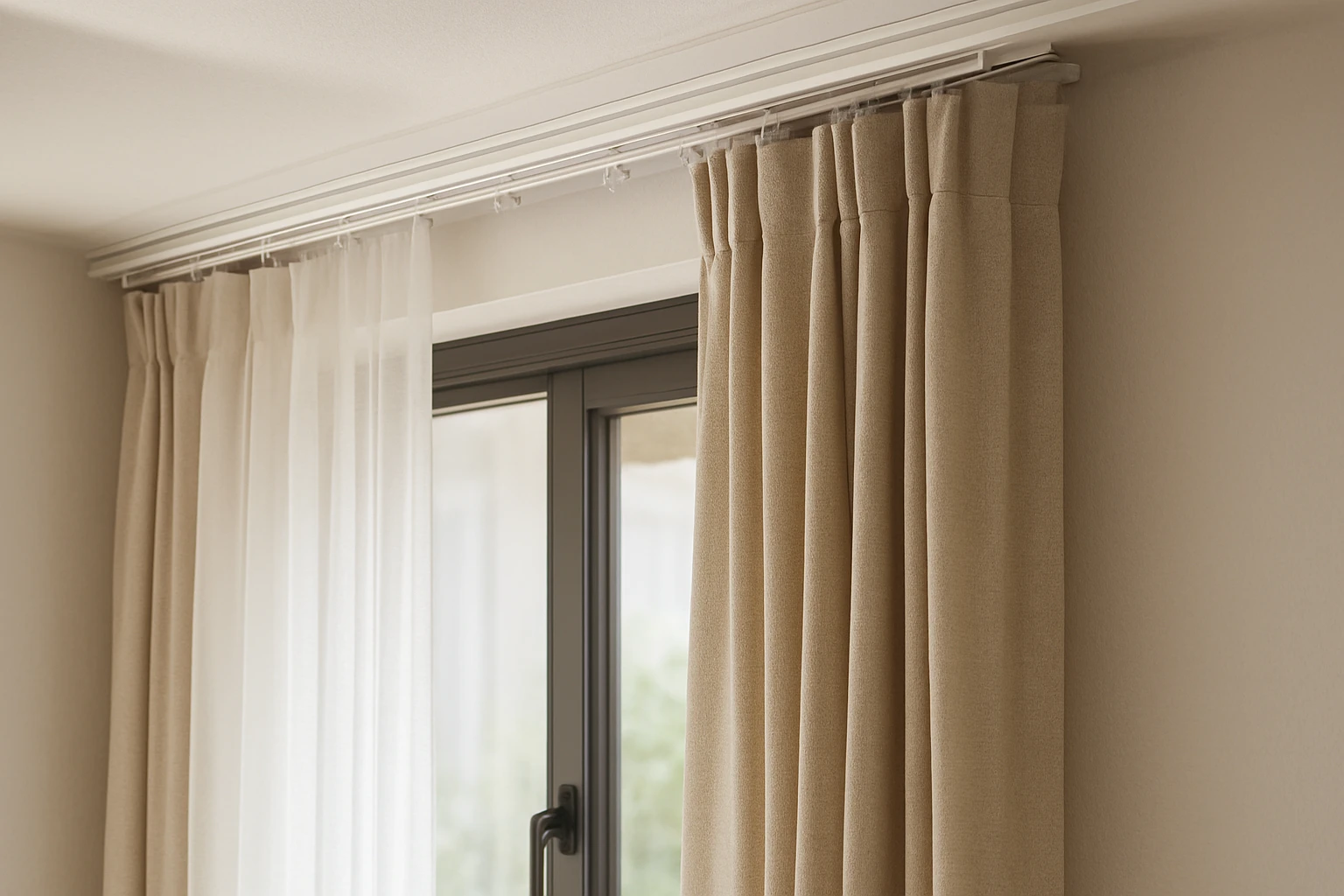
A suitable curtain track is often the most practical choice for a wide sliding door because the gliders can move along a continuous path. A pole can work well too, provided its brackets do not stop the curtain before it clears the opening.
| Hardware | Good Reason to Choose It | Detail That Can Cause Trouble |
|---|---|---|
| Ceiling-mounted track | A clean line above tall doors | A suspended ceiling may need extra support above it |
| Wall-mounted track | Useful where ceiling fixing is unsuitable | Brackets must project far enough to clear handles and folds |
| Decorative pole | Suits classic or relaxed interiors | Standard rings cannot pass ordinary center brackets |
| Double track | Allows separate sheer and opaque layers | Both tracks need enough depth and gathering space |
| Motorized track | Helpful for wide, heavy, or hard-to-reach curtains | Power, load capacity, and manual operation need checking |
A common mistake is choosing a long pole for its appearance without checking how the curtain passes the center support. Standard rings stop at that bracket, which may prevent a one-way curtain from moving across the full door. Some systems have special passing rings and brackets, but they must be designed to work together.
For either a track or pole, the wall and ceiling fixings must suit the surface and curtain weight. Do not assume a plasterboard ceiling can support heavy lined curtains with ordinary plugs.
A draw wand lets you move the curtain without pulling the fabric itself, which helps keep pale curtain edges clean. For homes with children, avoid loose hanging cords and ask for a cord-free or suitable child-safe control system.
If you are arranging curtain installation in Dubai, ask the installer to check the fixing surface, air-conditioning vents, handle clearance, and full curtain movement before confirming the track position.
How to Handle Strong Sun, Privacy, and Balcony Noise
For strong sun and nighttime privacy, choose an opaque or blackout curtain that covers the whole opening, with enough overlap at the sides and center. Fabric alone cannot block light coming through gaps around the curtain or stop noise coming through poorly sealed doors.

Blackout describes a fabric’s ability to block light through the material. It does not mean the whole room will be dark, because light can still pass above the track, below the hem, between panels, and around the sides.
For a bedroom, ask about overlapping curtain edges and side returns, where the fabric turns back toward the wall. These details can matter more than changing from one dense fabric to another.
On west-facing glass in Dubai, afternoon sun can create strong glare and add heat to the room. A light-colored lining facing the glass can reflect some sunlight, while a separate sheer layer lets you soften daytime glare without closing the heavier curtain. Curtains do not replace well-fitted glazing, shading, or working air conditioning.
A thermal curtain has a lining or backing intended to slow heat transfer. Do not assume every blackout curtain offers the same heat protection. Check the manufacturer’s product details rather than relying on the label alone.
Noise needs a separate check. Heavy curtains may soften echoes inside a room, but they will not soundproof a sliding glass door. If you are considering soundproof curtains, ask for evidence of how well the exact product works and how it needs to be fitted. Air gaps, worn door seals, and the glazing itself may remain the main paths for outdoor noise.
How to Match Curtain Color to the Room
Choose a curtain color that works with the wall and floor before matching small accessories. Sliding glass door curtains cover a large area when closed, so a color that looks subtle on a sample can become a strong feature at full size.

For a small room, curtains close to the wall color create a calmer background with fewer sharp color changes around the glass. This does not create more space, but it can make the wall feel less crowded.
Use a deeper shade when you want the curtain to be a feature. Muted olive, clay, blue, and charcoal can work well, though a large dark curtain becomes a strong block of color once closed. Check that effect from the sofa or bed, not just while standing beside the window.
Hold samples upright beside the wall in daylight and again under the room’s evening lights. A cool gray fabric can look blue beside cream walls, while an ivory curtain may look yellow next to bright white paint.
Take a photo with the sample in place, but make the final choice in person because phone cameras can change color. Also view the fabric from outside if the balcony or neighboring homes have a clear view of the door.
What to Buy First and Where to Spend More
Confirm the curtain layout, fixing method, and finished measurements before buying fabric. A modest curtain on a well-fitted track is usually easier to live with than an expensive curtain that catches on a handle or blocks the balcony.
For budgeting in the UAE, basic ready-made curtain pairs often cost roughly AED 100 to AED 500, while made-to-measure curtains for a typical sliding door can cost around AED 800 to AED 2,500 or more. These are broad planning ranges, not quotes. Prices vary by supplier, location, fabric, size, lining, and what the package includes. A wide double-layer set or motorized track can cost more.
| Spend More On | Where You Can Often Save |
|---|---|
| Strong fixings and a track suited to the curtain weight | A simple fabric rather than a complex designer print |
| Correct width, drop, and handle clearance | Standard ready-made lengths when they fit properly |
| Opaque lining for a bedroom that needs privacy | Decorative trims that do not improve daily use |
| Smooth operation on a frequently used door | Motorization when the curtain is light and easy to reach |
Ask each supplier to list fabric, lining, tracks, brackets, delivery, installation, and any alterations separately. A lower advertised price may exclude the parts needed to make the curtain work.
If there is too little space for gathered fabric, do not force a curtain into the opening. A roller versus vertical blind comparison can help you weigh other options, though a roller blind usually needs raising before you walk through the door.
For most living rooms, a practical starting point is a washable sheer on a smooth track, with an opaque layer added where evening privacy is needed. For a bedroom, start with light control and coverage around the edges, then choose the color and heading. In both rooms, keep the path through the door clear before making any style decision.
Frequently Asked Questions
Can I Hang Curtains Over a Sliding Glass Door Without Drilling?
You can sometimes hang lightweight curtains without drilling, but wide sliding doors make this difficult. Tension rods and adhesive brackets have load and span limits, so check the exact product rating before use. For heavy or lined curtains in a rental, ask the landlord about approved fixings rather than relying on an unsupported rod.
Can Blackout Curtains Go in the Washing Machine?
Blackout curtains can go in the washing machine only when the care label allows it. Some coated backings need gentle cleaning, while others require professional care, and excess heat can damage certain layers. Check both the face fabric and lining instructions, remove hooks where directed, and avoid assuming that all polyester curtains are machine washable.
How Do I Stop Curtains Blowing Through an Open Sliding Door?
Keep curtains gathered clear of the open doorway and secure them with a suitable holdback when the door is open. A weighted hem may reduce light movement, but it will not hold fabric safely against a strong breeze. Keep loose cloth away from the sliding track, where it can become dirty or caught.
Will Motorized Sliding Door Curtains Work During a Power Cut?
Motorized curtains work during a power cut only if the system has a charged battery supply or a supported manual release. These features vary by motor, so ask about them before ordering. Do not pull a powered curtain by force unless the manufacturer’s instructions say the track supports manual movement.
Can I Put a Curtain Track Inside an Existing Ceiling Recess?
A curtain track can fit inside a ceiling recess if there is enough space for the track, fixings, and moving fabric folds. A recess that suits one layer may be too narrow for sheers and lined curtains together. Check access for installation and future repairs, and confirm that the fixing surface can carry the load.